
Why does the banker bet in baccarat win more often at crypto casino games?
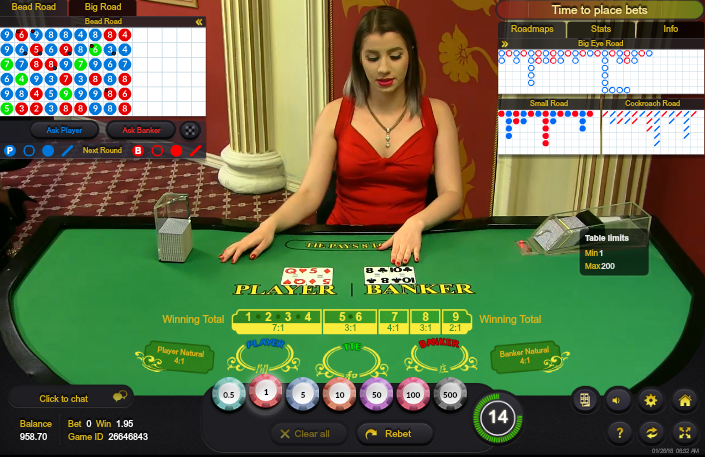
for crypto games casino crypto.games baccarat gives banker, player, and tie betting. The banker bet wins more rounds than the player bet because the drawing rules apply a conditional decision matrix to the banker’s hand that the player’s hand does not receive. Banker bets win approximately 45.86 percent of rounds, player bets win approximately 44.62 percent, and ties account for the remaining 9.52 percent. Both the higher win frequency and the five percent commission on winning banker bets exist because of this drawing rule structure, giving players the mathematical reasoning behind every baccarat bet type before their first funded session at compatible operators.
Conditional drawing rule advantage
Banker bets win more often because the banker’s hand draws or stands based on a conditional matrix that combines the banker’s own current total with the player’s revealed third card value. Player hands draw automatically on totals of zero through five without any conditional input, while banker hands use the player’s third card as additional information to decide whether drawing improves their position before the round concludes at compatible operators.
A banker holds a total of three draws against a player’s third card of zero through seven, but stands against a player’s third card of eight. Banker holds five draws against the player’s third cards of four through seven, but stands against zero, one, two, three, eight, and nine. This position-specific flexibility across every banker total from zero through six produces the statistical advantage that distinguishes the banker bet’s win frequency from the player bet’s across all possible round combinations at compatible operators.
Banker hand improvement probability
Across all possible baccarat hand combinations, the conditional drawing matrix gives the banker hand more opportunities to reach totals of seven, eight, or nine than the player hand’s fixed drawing rule provides. When the player draws a third card that would help the banker’s total to four, the banker draws to improve. When the player draws a card that would not help, the banker stands on a total that is already ahead of the player’s position. This conditional adjustment across every possible round state produces the banker’s higher win rate without any single drawing condition alone explaining the full advantage at compatible operators.
Players who want to review the full conditional drawing matrix can find it published within game documentation at compatible operators, where every specific draw-or-stand decision for each banker total and player third card combination is disclosed before session entry at compatible operators.
Commission versus win rate balance
Banker bet returns at compatible operators incorporate a five percent commission deduction on winning outcomes, reducing the net return from 1 to 1 to 0.95 to 1. Without this commission, the banker bet would carry a lower house edge than any other standard casino table game position at comparable operators. With the commission applied, the three bet type house edges are as follows:
- Banker bet – approximately 1.06 percent house edge from 0.95 to 1 return on winning outcomes
- Player bet – approximately 1.24 percent house edge from 1 to 1 return on winning outcomes
- Tie bet – approximately 14.4 percent house edge from 8 to 1 return on winning outcomes at compatible operators
Players who understand the commission structure alongside the win rate advantage recognise that the banker bet remains the lower house edge position despite the commission deduction, because the probability advantage it reflects more than offsets the commission cost across extended baccarat session participation at compatible operators.
Conditional drawing rules give the banker hand a win rate advantage through position-specific decisions based on the player’s third card. At approximately 45.86 percent, the banker win rate exceeds the player bet’s 44.62 percent, with the five percent commission calibrated to reflect rather than negate this mathematical structure at compatible operators.